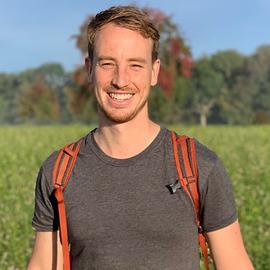
Grey Monroe
Assistant Professor (Associate effective July 1, 2026)
UC Davis Department of Plant Sciences
UC Davis Genome Center
UC Davis Climate Adaptation Research Center
Grey Monroe leads the Genome Change and Adaptation Lab in the Department of Plant Sciences at UC Davis, with affiliations in the Genome Center and the Climate Adaptation Research Center. He earned his PhD in Ecology with John McKay at Colorado State University and completed postdoctoral research with Detlef Weigel at the Max Planck Institute for Developmental Biology.
The lab studies the biology of mutation: where mutations arise in genomes, how DNA repair is targeted to the most functionally important regions, and how the mutational process plays out across development, generations, and evolutionary time. Work from the lab in Nature (2022) established that germline mutation rates in Arabidopsis are systematically reduced in essential genes, mediated by epigenomic recruitment of DNA repair. Follow-up work in The Plant Cell (2024) identified H3K4me1 as a histone mark that recruits mismatch repair (MSH6) and homology-directed repair (PDS5) through Tudor-domain readers, and eLife (2025) showed that this coupling between the epigenome and DNA repair machinery has evolved convergently across the tree of life.
A growing focus of the lab is somatic mutation. Plants are a uniquely powerful system for quantifying mutation in action: long-lived clonal genotypes, spatially structured meristems, and accessible lineage histories make it possible to measure mutation accumulation through time and space at a resolution that is difficult in most animal systems. The lab combines duplex sequencing, haplotype-resolved long-read genome assembly, and large-scale short-read sequencing of clonal lineages to characterize somatic mutation dynamics in walnut, cassava, poplar, and Arabidopsis, including work on tissue-culture-induced genome instability and the partitioning of mutation bias and selection during plant development.
The lab also builds pan-genomes and functional genomic resources for crop and wild plant species, including pistachio, walnut, cassava, alfalfa, einkorn wheat, celery, and poplar. Current projects connect population-scale genetic variation to the chromatin landscapes, genome architectural features, and repair pathways that shape which variation arises and persists. Tools developed by the lab include the polymorphology2 R package for genomic analysis, reCYCLing for satellite DNA evolution with ABC inference, and kolibri for long-read structural variant detection.
Grey teaches PLS 206 (Applied Multivariate Modeling for Agricultural and Environmental Sciences) and PLS 152 (Plant Genetics), and co-directs the UC Davis chapter of EnvironMentors, a high school STEM mentorship program.
Office: 262 Robbins Hall, UC Davis
- Mutation Biology
- Somatic Mutation and Genome Stability
- Epigenome-Recruited DNA Repair
- Pan-genomes and Crop Genomics
PhD, Ecology
Colorado State University (with John McKay)
Postdoctoral Research
Max Planck Institute for Developmental Biology (with Detlef Weigel)